








We couldn’t find what you are looking for. Please try another way.
Life at Multiverse

Thank you! Your submission has been received!
Oops! Something went wrong while submitting the form.

Meet the minds behind Mastry: Inside Multiverse's AI engineering team
Life at Multiverse
Team Multiverse
Seven minute read
Multiverse backs human agency: we want to make sure that everyone benefits from AI, not just the frontier AI labs who are building the models. That philosophy is baked into how we've built Mastry, our adaptive learning platform that builds AI skills in the flow of work, inside the apps people already use.
Behind Mastry sits an AI engineering team across Edinburgh and London, which Col Mackenzie, VP, AI Engineering, leads. We sat down with Col and asked him how his team came together, who they are and what makes them different.
In short: Multiverse's Edinburgh AI Hub began with one phone call. The team runs without hierarchy and hires for talent wherever it hides. Its leader worked as a professional magician for years, and its people include a member of the band Anchor Lane and an engineer who joined straight from a chip shop.
Let's dig into it.
As the leader of our AI engineering team at Multiverse, what does your role involve?
My job is to build every part of our AI engineering capability: the platforms we create, the software development lifecycle we follow and the culture that makes a team perform at a high level. I also lead our Edinburgh AI hub, and I want it to be the most appealing place to work in tech in Scotland.
There's one key idea behind my approach to leadership: to improve my own work, I need to be around people who are better than me. I know that I can learn something from everybody, whatever their background or seniority. I've had a varied career, and living and working alongside very different people proved that to me.
Why did Multiverse build an AI engineering hub in Edinburgh?
Jay Richman, Multiverse's Chief Product & Technology Officer, called me to ask if I'd consider a new role heading up the AI Engineering team. It was my first week of paternity leave in my previous role, and I wasn't looking to change jobs. But the problem Multiverse is tackling appealed to me. If we do our job right, we're building a product that will have a generational impact on the economy and society, making sure that technology works for people, not against them.
Then Jay mentioned three days a week in London. I have a family and I wasn't planning to move away from Scotland, so I made him an offer: open an office in Edinburgh and I'll run it. He came back the next day and agreed.
Scotland has a large, untapped talent pool, with strong AI-focused universities and a lot of research. More people are moving north for a different pace of life. I also had a good contact book of engineers, so we bootstrapped the hub quickly. Word spread from there.
The Edinburgh engineering team doesn't do anything different from the London team. We are one engineering team, working towards a common goal.
How do you build a team where everyone can contribute, whatever their seniority?
For me, there is no hierarchy, and that is hard to build. Someone told me recently that they weren't sure they could come to me directly. They thought they had to go to their boss first. I said, why would you? It doesn't matter if you're a junior engineer in a different part of the business. Come and talk to me.
Everybody makes a unique contribution, and the hidden gems often sit in unexpected places. That has held true throughout my career. It carries over neatly into software, because there are so many perspectives on how you build a product.
What did a career as a magician teach you about leading a team?
I still call myself a magician! I worked at it professionally for a long time: magic, hypnosis and pickpocketing (though I always gave everything back!). It taught me more than any other role I've had. I learned how to deal with stakeholders, how to deal with all kinds of people and how to manage under pressure. There were so many transferable skills.
Who is on the team, and what might surprise people?
Most of the Edinburgh office plays an instrument: bass guitar, drums, piano. Nobody sings, so if you can, you're welcome to take the stage…
One of our AI managers is in a band that's played Download Festival, one writes orchestral music; another used to play in a hard rock band.
Another member of the team can build almost anything. Years ago, before having access to AI, he wanted a 3D printer and couldn't buy one. So he researched the components, ordered a pile of electrical parts and built one from scratch. That's famously difficult to do.
Why does Multiverse hire junior AI engineers?
We're an upskilling company, so we should invest in the next generation. When I joined, the industry trend was not to hire juniors. I wanted the opposite. I was a mechanic once, and I learned from a proper journeyman (a skilled tradesperson in the field). I wanted to test that model in tech: pair a junior engineer with a high-performing senior and see if we can incubate their skills.
Then I got a message on LinkedIn from someone who was finishing his degree, asking if I had a job. I get a million messages like that, but his was good, so we spoke. He went through our full hiring process and smashed it. His only previous job was in a chip shop. Now he works in one of the best AI roles in the country, and he's exceptional.
How do those backgrounds show up in the work?
They think around corners. Give anyone on the team a problem and they find a creative route to it. That's what I like about solving problems in the office. If we stand at a whiteboard, there isn't a problem we can't solve, because someone has usually sketched out a whole solution and said, let's just try that. The ability to pull a solution apart and put it back together is very strong. It's fun, too.
Will AI replace people, and how does that shape the way you build Mastry?
Humans can be augmented with AI, as they have been with other technology. The industrial revolution let us manufacture faster. Well, AI lets us do knowledge work faster. You effectively have an expert you can ask anything, at any time, and you can hand tasks to it. But it still needs a huge amount of human context and judgement to get the best from it.
I think AI replacing people is unlikely, but AI replacing some work is certain. The transition will be the difficult thing to get right: people need to understand how their work changes when they can use AI to remove repetitive manual toil. That frees them for higher-level tasks and strategic thinking. What you do with the time back is up to you.
Meet Kelly Griffith, our new SVP of Coaching & Delivery
Life at Multiverse
Team Multiverse
Today Kelly Griffith joins Multiverse as Senior Vice President of Coaching & Delivery.
Coaching is one of the things our customers and learners tell us they value most. As a company that relentlessly backs human agency, we know the value that a direct relationship with a human expert can provide.
Kelly now leads the largest team at Multiverse. She joins from EZRA, the industry leading professional coaching platform, where she spent seven years as Chief Coaching Officer, building the coaching community from the ground up to over 4,500 professionals in over a hundred countries. A tested, qualified coach herself, she has done the work she now leads.
She also knew us before she joined us. Multiverse has been an EZRA customer, so she watched how we work from the other side of the table.
Kelly Griffith, SVP of Coaching & Delivery:
“The core of an apprenticeship has always been that key relationship between an expert and a learner. Scaling that in the AI era is a critical mission, and the brilliant team of Multiverse coaches have a special role to play.
“I’ve followed Multiverse for many years, including as a customer, but this moment, with the company accelerating growth and impact across Europe, feels like an inflection point. I’m thrilled to join.”
She joins to lead a team of expert practitioners. Multiverse coaches spend an average of five years working in industry before they coach in an area. More than 100 hold advanced degrees and there is an astrophysicist and a former Air Force Lieutenant among them.
Crucially, learners do not get one generalist stretched across the whole programme. The team is structured to ensure learners access the right specialists at each stage: Launch Coaches to set them up, Technical Instructors to teach the content, Cohort Coaches to drive application in the day job, and Success Coaches to see them through end-point assessment.
Calibre on the way in is only half of it. We hire, train and evaluate every coach against our Compass Framework, and coaches then complete an average of 60 hours of technical upskilling a year to stay current. Our learners consistently rate their coaches above 9 out of 10.
Kelly's first priority is time. Specifically, giving it back to that team.
That work is already underway. Atlas, our AI coach, has cut the share of coach time spent on routine support from 41% to 18%, resolving 88.3% of inbound queries about scheduling and platform navigation. Atlas answers the questions that require a response within 5 minutes at 11pm at night. Coaches answer the questions that fundamentally affect how someone works. Kelly now owns how those two things fit together across 40,000+ learners in the UK and Europe.
Euan Blair, CEO and Founder of Multiverse:
“As AI procurement continues at pace, there’s a gap opening up between the capability of the tools and the capability of the workforce to use those tools.”
“Our expert human coaches are a key part of closing that gap: they drive accountability and guide learners to apply their skills in meaningful ways. Kelly built one of the largest coaching operations in the world, and we're delighted to have her now leading the largest team at Multiverse.”
We sat down with Kelly in her first week for a interview on why she joined, and what she's looking forward to most.
What are you most excited about?
"Unlocking time for our coaches. Creating time for them to drive the most impact with learners.
"AI adds real value in the flow of work, for time constrained tasks and the urgent things you need help with right now. That work does not need a human doing it.
"But at the core of it, the human coaches are the ones who then have more time to work with learners on their goals, their ambitions, their values, what motivates them. To help them unblock challenges and become the best they can be in the workplace."
Why Multiverse?
"Every business now has to show how it builds value from AI. Multiverse is a long way ahead of the market on that. That is exciting to walk into."
What will coaches notice first?
"Time with me, and time with each other.
"Coaches are the most wonderful group of people to work with. Many of the best are senior individuals moving into another chapter of their careers, people who see people development as something they love doing. Multiverse coaches are cut from the same cloth.”
Meet Colin Mackenzie, Multiverse's new VP of AI Engineering
Life at Multiverse
Team Multiverse
Earlier this month we announced the opening of Multiverse's new tech hub in Edinburgh, Scotland — and the leader who will build it. Colin Mackenzie joins as VP of AI Engineering, bringing a career that spans race car mechanics, professional magic, and building frontier AI systems at Amazon.
We sat down with him in his first weeks to hear about the journey that led him here, what he believes AI is doing to the engineering profession, and what he hopes to build in Edinburgh.
Tell us about yourself. You've had quite a career path…
It's been a relatively non-traditional journey. I started out as a mechanic and performance tuner, building Japanese race cars, later pivoting into being a full-time magician, picking pockets and hypnotising people around the world. A final pivot into tech saw me work across start ups, fintech and latterly at Amazon building out the generative AI products.
The thread through them all is engineering: mechanical, social, and software. They all require systems thinking, problem solving, and figuring out how to innovate.
The last chapter moved extraordinarily fast. Working with the team at Amazon, we were building frontier AI systems in ads before the generative AI wave really hit. Every technology shift I'd seen in the past few decades, I've experienced ten times over in the last two or three. It's been quite a ride.
AI is changing what's possible in engineering at pace. What's your take?
The biggest shift is the collapsing of roles. Traditionally, there were clear boundaries between designers, product managers and engineers, and a well-worn process for passing work between them. AI is dissolving and reimagining all of that.
Knowledge is no longer a moat. If you deeply understand how to build systems, AI now gives you the ability to think more like a product person, ask better customer questions, and experiment with design. And the inverse is true: a designer, with solid systems thinking, can now build scalable products they couldn't before. The people who will thrive are the ones curious enough to explore at those edges.
The cycle time has collapsed too. We used to talk about two-week sprints. Now you can ship new features on a daily basis, get real customer feedback, and iterate the same day again. If we can set ourselves up to move at that speed, we can build something genuinely differentiated.
If anyone tells you they're a generative AI expert, take that with a pinch of salt. The technology changes week in, week out. The only honest posture is a beginner's mindset. Keep being curious, keep pushing, don't stagnate.
You’ve spoken about building a learning organisation within a learning organisation. What does that mean to you?
I came up through a traditional apprenticeship as a mechanic. I was paired with a journeyman — an expert who taught me everything they could. I had two or three of those over the course of that career, and I absorbed the best of what each of them had to offer.
There's a trend in the market right now that worries me: the idea that AI can replace junior engineers, so companies stop hiring them. But if we stop training the next generation, we lose the pipeline of people who will eventually become the experts. We need to operate like a learning factory. Knowledge might be freely accessible now, but only experience teaches you how to apply it thoughtfully. Creating an environment to disseminate the hard-won experience of tenured engineers into the people earlier in their careers, in a structured, thoughtful way, is critical.
And it doesn't only apply to juniors. An exec who wants to get closer to design, an engineer who wants to understand the product side better — that model works for everyone when you have AI in the mix. The boundaries between roles are blurring. We should be helping people move across them.
What are you building in Edinburgh, and what excites you most about the mission?
The opportunity to build something in Scotland that has genuine economic impact — not just on this company, but on the next generation of builders and on the tech ecosystem. Edinburgh has a deep concentration of world-class engineering and AI talent. The universities are actively encouraging AI experimentation. There are ambitious companies already emerging here. It is a small city, but remarkably rich in the opportunities it offers.
What I want to build is a hub that attracts that talent, compounds over time, and becomes an employer of choice in Scotland. But I'm equally clear about what I don't want: an annex. I don't want Edinburgh to feel like a satellite office with a flag planted in it. Whatever we build here should be genuinely integrated with Multiverse as a whole — incubating ideas, levelling up skills, working as one team. If we get that right, I think we'll build something quite remarkable.
Reporting our Gender Pay Gap 2025
Life at Multiverse
Paige Rinke, VP People & Talent
This week, we reported our gender pay gap for the 2024-2025 tax year. The report offers a snapshot of Multiverse's gender pay gap on 05 April 2025, the government's date for private sector reporting. At that time, we had 570 employees in the UK.
Headlines
- Our mean pay gap decreased in 2025 to 10%, which remains lower than the average gender pay gap in comparable sectors.
- Our mean bonus gap declined from 33.2% to 21.5%, and our median bonus gap remains low at 4.5%. With a similar proportion of men (77.5%) and women (78.2%) receiving a bonus during this period, this indicates that bonus distribution across the organisation is largely equitable.
- Women continue to excel in our Sales organisation, representing 80% of our top five highest-earning commission roles at the snapshot date, despite making up approximately 30% of the total Sales team.
The Gender Pay Gap explained
First - some technical bits. The gender pay gap is the difference between the average hourly pay of men and women within an organisation. The UK government requires businesses with 250 or more employees to report on the following metrics each year:
- Hourly pay gap - mean and median
- Bonus pay gap - mean and median
- Proportion of men and women receiving a bonus
- Proportion of men and women in different earnings quarters
The gender pay gap is distinct from unequal pay, which is illegal in the UK and has been since 1970. At Multiverse, we take active steps to ensure there is equal pay for equal work at all levels within our business, for example regular pay audits and benchmarking. Reporting on our gender pay gap is an important moment for us to reflect on the initiatives we introduce to embed fairness and equality of opportunity in our business, and whether these are successful.
A note - HMRC specifies that Gender Pay Gap data sets should only include people who identify as a man or woman. Multiverse employees can voluntarily complete a series of census questions through our HR Information System, including their gender identity. To align with HMRC's guidelines, we have excluded any employee who has self-identified as 'Non-binary' or 'Another gender identity', although this approach is not in line with our internal pay audit practices or overall approach to gender identity and equality.
Key Figures
As a reminder, this report is retrospective and covers the period between 6th April 2024 - 5th April 2025, with a snapshot date of 05 April 2025.
Pay Gap
In the UK, Multiverse's mean gender pay gap was 10%. This means that the average hourly pay of a man at Multiverse was 10% higher than the average hourly pay of a woman.
Multiverse's median pay gap was 13.3%. The median pay gap is the difference between the salary in the middle of the range of all employees who are men, compared to the middle salary among all employees who are women. At Multiverse, the median man earned 13.3% higher than the median woman. The reason we look at the median is because it reduces the impact of any outlier values.
According to the House of Commons Library (ONS), the 2025 UK median gender pay gap for reporting employers was 11% (source, p.12). Research also tells us that the mean gender pay gap in both the Technology and Professional Services sectors is approximately 15% (source), which are the sectors that offer the best comparisons to Multiverse. However, recent industry research suggests that for some areas of the UK technology sector, the gender pay gap is as high as 17.5%, with 42% of top tech firms seeing their gap rise or stay the same since 2021 (source).
Bonus Gap
In the reporting period, 77.9% of Multiverse's UK employees received a bonus - 78.2% of women, and 77.5% of men.
Our mean gender bonus gap declined from 33.2% in 2024 to 21.5% in 2025. This means that on average across the 12 months leading up to 05 April 2025, the bonus of a man at Multiverse was 21.5% higher than the bonus of a woman.
Our median gender bonus gap increased from -16.5% in 2024 to 4.5% in 2025. This means, the median man at Multiverse had a bonus 4.5% higher than the median woman. Our median bonus gap differs significantly from the mean gap because the median factors out some of the impact of outlier bonus amounts. There's higher year-on-year variability in the bonus gap because of the performance-related nature of our bonus and commission plans. We will explore this in greater detail, later in the report.
Across all reporting employers in 2025, on average, 38% of women and men received bonuses, and in 64% of reporting employers, median bonus pay was higher for men than for women (source, p.12-13).
Earnings Quarters
From 2024 to 2025, we saw an increased proportion of women in the middle quarters, and a decreased proportion of women in the upper and lower hourly pay quarters.
Overall we have more men in our highest paid roles and more women in our lowest paid roles. Over-representation of men in high-earning roles is a systemic driver of the gender pay gap; it is at these levels where the most significant pay gaps exist and they have been the slowest to narrow (source, p.31). While this remains true for Multiverse, we have made progress and continue to work towards a gender-balanced organisation.
Gender breakdown by pay quartile

Explaining our Data
We are pleased that our mean gender pay gap has decreased and remains lower than the average for the UK Tech and Professional sectors. In pursuit of this goal, we will continue to work on identifying the causes of our pay gaps and how we can close these. This section sets out some key factors which have influenced our pay gap data this year.
Impacts on Pay
Sales Commissions: Commissions and other bonuses paid in the month of April are included in our calculation of an employee's ordinary pay, as required by the UK government. At Multiverse, the only bonuses paid in April are Sales commissions. On the snapshot date, 72.5% of our Account Executives (the quota-carrying Sales roles) were men. However, 80% of our top 5 highest-earning Sales reps, based on April commission, were women. This reflects the overall industry picture; women make up approximately 30% of all Sales roles however have higher quota attainment (source). It is important to note that commission payments reflect individual in-year performance, and this picture can change year-on-year.
Distribution and Representation: In 2025, we saw decreased representation of women in both our upper and lower pay quarters. Typically, a reduction of women in the lower pay quarter is a positive driver for closing the gap, as it indicates fewer women are concentrated in the lowest-paid positions. This contributed to the decrease in our mean pay gap.
However, our median gender pay gap increased. This is because the decrease in representation of women at the upper pay quarter (which corresponds to Director level and above) was more significant than the reduction at the junior levels. This shifted the middle salary point, so that the median woman at Multiverse was paid less than the median man. While our Executive team remained gender-balanced in April 2025 - a benchmark we are proud of compared to the FTSE 350 average (source) - these roles are the highest-paid in the organisation. As outliers, they impact the mean but are excluded from the median calculation. Effectively, while we have improved the gender balance in our entry level roles, the reduction of women in the senior leadership layers immediately below the Executive level remains the primary driver of our median gap.
Impacts on Bonuses
Our mean bonus gap decreased to 21.5% in 2025. While moving in the right direction, it remains high due to the over-representation of men in senior roles where bonus potential is higher.
In contrast, our median bonus gap was 4.5%. As the median figures lessen the impact of outlier figures on each end of the spectrum, it provides a clearer picture for the typical Multiverse employee. There is an inherent variability in our bonus pay gap figures because of our "Pay for Performance" Reward philosophy. Because payouts are tied to individual performance ratings, we typically see more significant year-on-year changes in the bonus gap; this is expected and reflects the performance-driven nature of our plans.
However, a low median bonus gap suggests that at the mid-point of Multiverse, men and women are receiving similar bonus amounts. This indicates that for the typical employee, our performance framework and bonus policy is being consistently and equitably applied.
Our Approach to Closing the Gender Pay Gap
We believe that increasing rigour and specificity across our People processes is the most effective way to ensure fairness and transparency. By standardising how we evaluate performance and reward our talent, we aim to "level the playing field" and reduce the impact of unconscious bias in decision-making.
Starting in April 2025, we have undertaken a year-long review and evolution of our performance framework to further increase this rigour. While the implementation of this new framework - which covers everything from hiring to internal performance assessment - is outside the scope of this retrospective report, it represents our ongoing commitment to embedding equity into every People process.
We believe our data-driven approach to pay and performance across the 2024-2025 period has been key to our progress:
- Evidence-Based Reward: We have continued to mature our 'Pay for Performance' philosophy to ensure all compensation decisions are equitable and evidence-based. Central to this is our structured bonus model, which ensures each performance rating correlates to a single, standardised individual performance multiplier. By using a structured approach that removes individual discretion from bonus calculations, we reduce the risk of subjectivity and unequal payouts. We believe the impact of this consistency is reflected in our low 2025 median bonus gap.
- Robust Calibration: Our performance review process relies on multiple rounds of calibration across different levels of leadership to ensure ratings are applied consistently and fairly. Unlike many organisations, we do not use a forced distribution curve. Research indicates that forced rankings may penalise high-performing talent from under-represented groups (source). Instead, we use a shared set of criteria to provide a data-led foundation for measurement. The calibration process then allows us to integrate stakeholder feedback and self-input to ensure we have mitigated bias in the assessment process. This allows us to reward true high performance and identify where support is needed, without penalising employees through a purely formulaic approach.
- Data Oversight: During each cycle, we provide an additional layer of scrutiny by reviewing performance ratings against diversity data at a macro level to check for potential unconscious or structural bias. We move beyond a department-led view to specifically scrutinise outlier distributions and ensure that every area of the business has applied our criteria fairly and consistently. By maintaining this macro-level oversight, we ensure that performance outcomes are a true reflection of contribution, providing a more accurate foundation for pay and progression decisions.
Conclusion
While the 2024-2025 gender pay gap report provides an important annual snapshot, our focus on organisational fairness is a continuous priority. As we continue to scale and grow at pace, we are committed to the robust systems and processes that allow us to find and reward talent from all backgrounds, ensuring that fairness remains fundamental to how we operate at Multiverse.
Meet Multiverse’s new Chief Product Officer
Life at Multiverse
Team Multiverse
A native New Yorker with a career built at the intersection of culture and technology, Jay’s fingerprint is on some of the most foundational tech products of the last two decades. From the early days of Hulu to a decade-long tenure helping scale Spotify from a startup to a global powerhouse, and most recently leading AI-driven commerce systems at Amazon, Jay has a proven track record of finding the next before it becomes the now.
Now, he’s moved to London to lead the next phase of the Multiverse product journey. We sat down with him on his first day to talk about his bet on the future of AI, the cultural discipline of dogfooding, and the lessons in timing he’s carried from Spotify and Amazon to Multiverse.
As you start this new chapter at Multiverse, what’s one cultural ritual you’re excited to establish to ensure we keep building at the highest possible standard?
Dogfooding.
We should never subject customers to an experience we would not subject ourselves to. If we are lifelong learners, we should be taking the courses we offer and using the products we build as real customers do.
If something frustrates us, confuses us, or feels harder than it should be, we fix it. And we fix it quickly.
We are only as good as the product we put into the world. There is no such thing as a great team building a bad product. And there are no great products that emerge by accident from teams that are not deeply invested in the experience.
To be truly customer obsessed, we have to live with our products every day. We should feel embarrassed when they fall short and genuinely proud when they delight.
That discipline is how high standards become a habit.
Every great CPO leaves a fingerprint on the team they lead. When you look back two years from now, what would you like Multiverse to be known for in the tech community?
I’d like Multiverse to be known as the company that took a different bet.
While much of the tech industry is focused on humans making machines smarter, Multiverse focused on building machines that make humans smarter.
I’d want us to be known for proving that AI can strengthen judgment, accelerate learning, and expand human capability in real work, not just automate tasks or generate outputs. For building systems that people trust because they genuinely make them better at what they do.
If the tech community looks at Multiverse and sees a company that chose depth over hype, capability over convenience, and long-term human impact over short-term efficiency, that’s a fingerprint worth leaving.
That reputation would matter more to me than any single product or feature.
Describe your career in your own words.
I’d describe my career as a long arc of building at the edge of what’s next, and learning a lot about timing along the way.
I’ve always been drawn to inflection points. Moments when technology shifts behavior, but the path forward isn’t obvious yet. I tend to spot those trends early and lean into them, even when the outcomes aren’t guaranteed.
Sometimes that meant being too early. Early in my career, I worked on one of the very first consumer mobile apps built for the Palm Pilot pre-smartphone era. The idea was right, but the world wasn’t ready. The devices needed cellular connectivity, a real app ecosystem, and infrastructure that simply didn’t exist yet. That experience taught me an important lesson: innovation isn’t just about seeing the future, it’s about understanding what needs to be true for it to arrive.
Other times, it meant being early but patient. I was part of the launch of Hulu, one of the first major video streaming platforms. While the direction was obvious, mainstream adoption took years to develop. Consumer behavior had to catch up and the industry needed time to recalibrate.
At Spotify, the timing was different. The world was ready after Napster. People clearly wanted on-demand access to music. But the business model didn’t exist yet. That challenge required innovation across product, monetization, creator economics, and licensing. It wasn’t just about building a great experience, it was about inventing a system that could sustain it.
More recently at Amazon, I’ve been working exclusively on AI products since the moment ChatGPT launched in November 2022. What immediately stood out to me was not just the capability of the technology, but the speed at which it would reshape work itself. That recognition has driven my focus ever since: not just on what AI can do, but on how it changes skills, roles, and expectations.
Looking back, the common thread is a deep curiosity about where things are going, a willingness to act early, and a growing appreciation for timing, execution, and systems that can turn breakthrough ideas into lasting impact.
What’s your fun fact!
The first time I ever went skiing was in college, and I did it in the least sensible way possible.
I had never skied before. I’d never taken a lesson. I joined the ski club anyway, bought second-hand boots and skis that were far too long, wore jeans, a thin shell jacket, no helmet, and went out on opening night.
It was about -29°C, after dark, and the only trail open on the mountain was a double black diamond.
It took me nearly two hours to get down. Every crash meant my skis and poles were scattered somewhere uphill, so I had to hike back up to collect them before continuing. When I finally made it to the bottom, exhausted and frozen, I got back on the lift and went again.
I’m not sure what that says about me, or how “fun” the fact really is, but it’s one of those stories people tend to remember.
Jay’s arrival marks a new chapter for our Product and Engineering teams, one defined by high standards and a relentless focus on human-centric AI.
If you are a builder who wants to join us on our journey, we’re hiring across our Tech team. Click here to see our live jobs.

The Future is… Built in a Week: Inside Multiverse’s Latest Hackathon
Life at Multiverse
Jafar Soltani, Senior Director of Engineering
That’s why, at the start of last quarter, we decided to put the roadmap "on ice" for one week. We paused our standard tickets for our bi-annual Hackathon, inviting everyone across the Tech org, including Engineers, Product Managers, Designers, Security, Data Privacy, and IT to come together and build something new and innovative.
The theme? "The Future is..."
To get into the right headspace, we left our usual desks and set up shop at a dedicated space external to our Paddington office. Tool-wise, we used Backstage, our internal developer portal, in addition to the SkillExchange plugin to crowdsource ideas.
The result? 25 distinct pitches
On the Thursday before the event, idea owners pitched to the group, rallying teams around their vision. We then kicked off Monday with our VP of Engineering, Helen who set the goals for the week. But we didn't just want to code; we wanted to learn. We invited guest speakers from Tessl to discuss evaluating AI agents, and Cursor to share best practices on leveraging AI for product and engineering workflows.
With teams formed and skills matched, the middle of the week was dedicated to deep work. The energy was electric. Teams mixed seniority and discipline; mid-level developers leading discussions and Product Managers getting hands-on with the code.
We saw a massive surge in AI adoption and Developer Experience tooling, balanced with a strong focus on directly improving the experience for our customers and learners, here are some examples:
- Learner experience: Many projects focused on improving the learner experience, such as linking learning directly to a learner’s project problems, personalising content for greater relevance, and designing gamified journeys that reward progress to drive daily engagement.
- AI agents and knowledge capture: One team designed a multi-agent system to automate support ticket research. Another team built bots to reduce repetitive Slack questions. Two groups tackled the challenge of retaining "tribal knowledge" by using Retrieval-Augmented Generation (RAG), unifying various scattered sources and transforming every GitHub PR and Linear Ticket into queryable institutional knowledge, not only improving developer experience but accelerating onboarding time for new joiners.
- DevEx wins: Teams built tools to automate code changes across multiple repositories, and smart test-selectors that identify exactly which tests to run based on codebase changes.
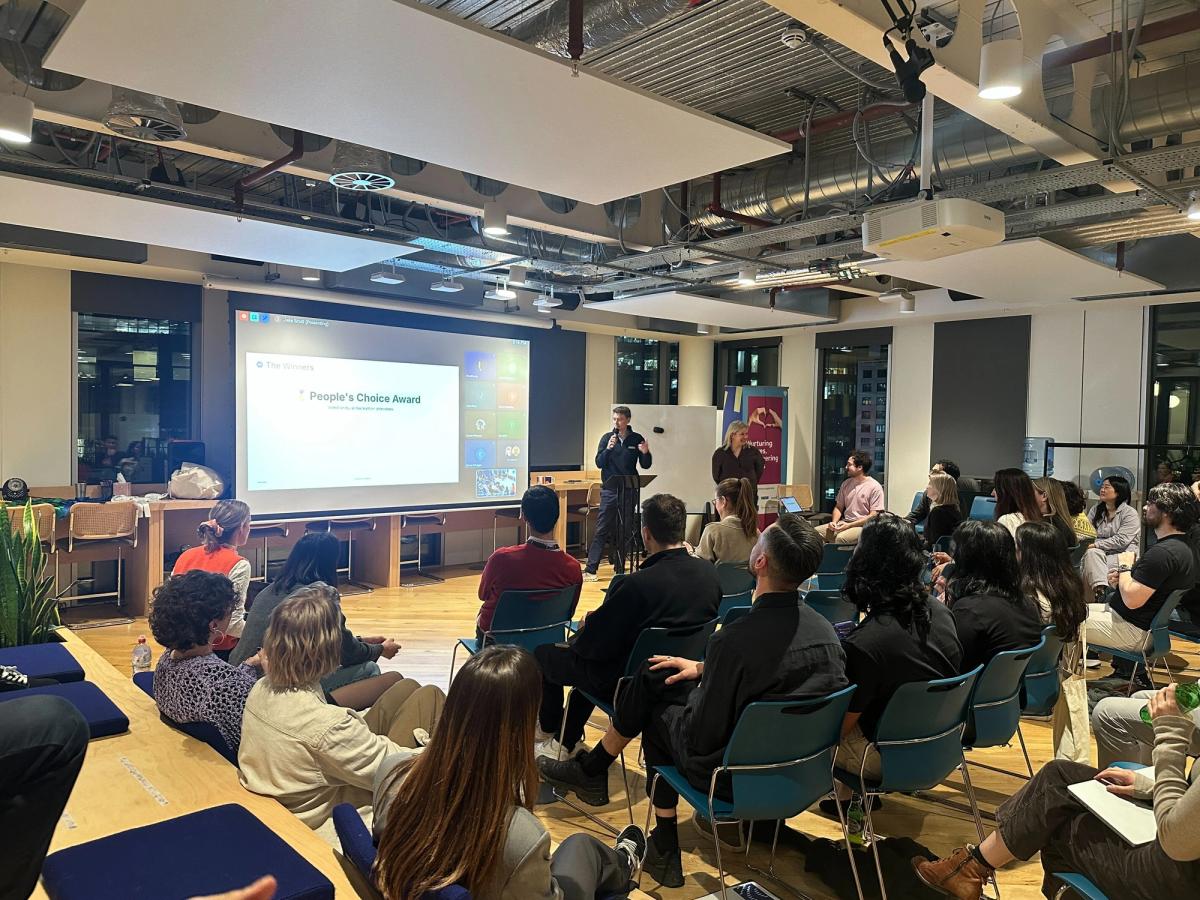
Thursday was the finale. Every single team presented a strict, three-minute pitch to show what they built in just three days.
Our Founder and CEO, Euan Blair, joined senior leaders from our Tech and Customer Success organisations to judge the projects across three specific categories:
- Most Impactful: How significantly does this improve the experience for customers, learners, or employees?
- Most Innovative: Does this push boundaries? Does it use AI in a novel way?
- Most Likely to Ship: How feasible is this? Can we realistically implement it?
We also had a People's Choice Award, voted on live by all hackathon attendees.
The shining light of the week though, in addition to the seriously impressive work in just a couple of days, was the collaboration and team culture we saw. Seeing people who might not usually work together, the diversity of opinions, and watching mid-level devs step up to lead complex projects was the real win.
“What stood out most was the speed to prototype, curiosity, collaboration, and care our teams brought to every idea. Seeing everyone learn from each other, explore new possibilities, and have fun together reminded me why moments like this are so special!”
- Helen, VP of Engineering
We aren't letting these ideas gather dust. We have already reviewed these to decide how best to productionise them and officially add them to our roadmap.
Does this sound like the kind of engineering culture you want to be part of? We are actively hiring in Tech, see live roles here.

Joining forces to shape the future of work: Multiverse acquires StackFuel
Life at Multiverse
Team Multiverse
We are thrilled to announce that Multiverse is officially expanding into Germany through the acquisition of StackFuel, the country’s top-rated data and AI training provider.
For anyone looking to join a company that is not just growing, but actively reshaping the European economy, there has never been a more exciting time to be here.
Our Growth Trajectory
This expansion comes at a time of strong momentum for Multiverse:
- Financial Strength: We recently surpassed the $100 million annual revenue milestone.
- Accelerating Growth: We’re adding more than 100 roles to our team this quarter.
- Operational Excellence: Alongside this growth, our EBITDA continues to improve, proving that we are building a sustainable, high-impact business for the long term.
The Mission: Solving Germany’s Digital Skills Gap
Germany is Europe’s largest economy, built on a foundation of industrial excellence. However, even the strongest economies face challenges. Currently, the German economy is at a crossroads: by 2040, it is projected to have a gap of over 660,000 unfilled IT roles, specifically in Data and AI. Six out of ten workers will need significant reskilling by 2030 just to keep pace.
The demand for change is coming from the ground up, but the supply isn't there yet: While more than 61% of German employees say they want AI training, only 5% of German companies currently provide it to all their employees.
This is where Multiverse comes in, to do what we do best: bridge the skills gap through high-quality upskilling programmes.
Why StackFuel?
To kick-start our entry into the German market, we knew we needed a partner that shared our values and our commitment to excellence. StackFuel is the leader in German data and AI training, bringing with them:
- A Proven Track Record: A reputation as the country’s top-rated training provider, with a 92% completion rate on their programmes.
- Practical learning: Their commitment to hands-on learning mirrors our own, with 90% of their training occurring in real business environments.
- Enterprise Relationships: A prestigious roster of Germany’s leading enterprises already using their platform, including Mercedes-Benz, Telefónica, Telekom, Siemens, and Miele.
- Government Trust: StackFuel holds the AZAV accreditation, the gold standard for government-funded training in Germany, providing regulatory funding for upskilling.
- Expert Talent: A team of specialists who understand the local market and the nuances of the German industrial landscape.
By combining Multiverse’s advanced AI expertise and financial firepower with StackFuel’s deep-rooted trust and reputation, we are creating a powerhouse capable of equipping the German workforce with the tools they need to thrive.
100,000 Careers, Transformed
Together with the StackFuel team, we have set a bold, immediate goal: to train 100,000 German workers.
This is the kind of scale and impact that defines Multiverse. We are building the infrastructure for the future of work, and we’re doing it across borders.
Join Us on the Journey
For those looking to build a career with impact, there has never been a more exciting time to work at Multiverse. When you join us, you are joining a company that is:
- Scaling rapidly: We are expanding our reach to help more people solve problems and unlock efficiencies through AI.
- Mission-driven: We believe our social contract depends on empowering everyone to benefit from AI opportunities.
- Innovation-focused: We derive learning goals from corporate strategies to ensure we are delivering the most relevant, future-ready skills.
As we scale our operations across Europe and continue to innovate in the AI upskilling space, we are looking for builders, thinkers, and changemakers to join our team. If you want to work at a company where your contributions move the needle on a global scale, we’d love to meet you.
Career Mobility at Multiverse: FY25 Update
Life at Multiverse
Serena Vaughan, People Enablement and Career Mobility Lead
We partner with over 1,500 of the world’s leading companies to build the critical skills their people need for the future, focusing on the AI, data, and technology capabilities that drive transformation. We believe this is the most direct path to unlocking both business growth and profound economic opportunity for people.
Our mission is brought to life internally through our Career Mobility strategy. It’s our commitment to our own team, built on the same principles we champion externally. Career Mobility is how we drive high-performance, create clear development pathways, and enable Multiversers to become their most AI-enabled selves.
Career Mobility 2.0
When we launched our Career Mobility strategy, we identified gaps in our approach to Diversity and Inclusion. As a result, our focus in 2024-2025 was mastering the tactical layer - specifically, further improving our performance and development ecosystem, and strengthening our culture of belonging.
Career Mobility represented an evolved approach, where equitable principles were embedded into our people strategy, instead of existing alongside it - to improve outcomes for all employees, including those from under-represented backgrounds, as a result.
For 2025-2026, we’ve simplified our framework to focus on two pillars, Empowered Careers and Empowered Culture.
Where is Multiverse today?
Our Data:
We focus primarily on collecting data related to characteristics which are protected under the law. As a result, our current focus areas are gender, ethnicity, disability (and neurodiversity), sexuality, religion and belief, and age. We also collect additional data including socio-economic status (social mobility), armed forces status and history, and parental and caregiving status because we believe this data is important in assessing our policies, processes, and benefits. The data in this report is a reflection of Multiverse as of July 2025.
Gender

49% of our population identify as women, surpassing the 29% of women in the UK tech sector, and 28% of women in US tech.
We know that one of the key drivers of our gender pay gap is representation of women at Director and above levels. 45% of our Director+ employees identify as women and 50% of our external hires at this level were women in FY25.
Since April 2024, we have appointed a new COO, CFO, both of whom are women, and appointed our Chief of Staff & Chief Performance Officer to the C-Suite team. This means our Executive team is currently gender balanced, which is something we are proud of. To put this in context, women occupy 43% of board positions and 35% of Leadership roles at the FTSE 350 level (source).
Ethnicity

56% of our global employees identify as White, compared to 68% in April 2024 - while 26% of employees identify as being from an underrepresented ethnic background vs 32% in April 2024. We attribute these shifts being primarily due to new joiners not completing our voluntary HRIS survey - something which we’re actively working to improve.
Despite this, we remain in-line with the UK Tech industry, where 25% of employees identify as being from an under-represented background. 7.5% of our employees identify as Black, compared with 5% in UK tech, however 9% of our employees identify as Asian which is below the 18% average in UK tech.
Our hiring data shows that our employee base reflects the diversity of our applicant pool, and that there are no stages in our recruitment process where we see disproportionate drop-out rates.
Sexuality

We’re proud that 13% of our employees identify as LGBTQ+, increasing from 12% in April 2024.
A comparative data set for sexuality was unavailable.
Disability & Neurodivergence


Our declaration rate for disability has significantly improved since April 2024, meaning around 5% of our workforce identifies as having a disability (physical, mental health, or learning-related). While this is just below the average of 6% in UK Tech, this has increased from 3% in our previous report.
Separately, almost 15% of our employees identify as neurodivergent. This is significantly above the 3% reported by UK Tech employers and is in line with the UK population figures.
Career Mobility in Action:
Case Study: Count Me In
In our first Career Mobility report, we identified that our voluntary employee census did not capture the information we needed, and that the majority of our employees had not self-declared.
To address this, in 2024, we refreshed the voluntary diversity questions we ask employees, to ensure we were in line with best practice and only collecting relevant and useful data. We now ask 11 global questions, with 3 additional UK-specific and 2 additional US-specific questions. This was a rigorous process, involving external research and benchmarking, and consultation with employees.
At the same time as refreshing our question set, we launched Count Me In, a campaign which aimed to increase declaration rates by educating employees on why we ask these questions and sharing in detail how the data is used. In the two-week campaign period, our average declaration rate increased from 46% to 65% - a result we are incredibly proud of and hope to build on. Already, this campaign has positively impacted employees; for example, we have increased our UK paid secondary partner leave (paternity leave) from 4 weeks to 6 weeks for employees with over two years tenure, the business case for which was supported by Count Me In data.
We’ve also since aligned the voluntary questions we ask in the recruitment process to align with our new internal survey as well.
Case Study: Lift All Boats
In line with our new mission of ‘equipping the workforce to win in the AI era’, we launched Lift All Boats in Q2 as part of our journey to enable every Multiverser to become the most AI-enabled version of themselves.
The first building block for this was Everyday AI, 90-minute interactive hands-on sessions, where the average attendee saves 4 hours/week on their work This session is built for those new to or experimenting with Gemini - no prior AI knowledge is assumed. Our expert coaches work with participants to show different prompting techniques and tailored use cases to help employees think about how they can start applying AI to their work.
This was followed by AI Skills Accelerator (AISA), a custom, 12-hour, 4 module AI course hosted in our Learning Platform and delivered by our expert coaches/instructors, as well as further Everyday AI sessions covering AI automations, NotebookLM and Advanced Gems. AISA was built for Multiversers looking to build their knowledge of AI, learn how to prompt effectively and understand how to implement data in their usage of AI and ultimately augment their ways of working at Multiverse.
To date (Oct ‘25), 537 and 184 Multiversers have taken part in Everyday AI and AISA respectively, with an average increase in Gemini usage of 24% above the rest of the business.
Case Study: ERGs at Multiverse
As well as equitable policies, processes, and practices, building an inclusive culture is a key focus for Multiverse because we know this enables and inspires our people to perform.
We currently have four ERGs:
- Black@Multiverse
- Disabilities@Multiverse
- LGBTQ+@Multiverse
- Women@Multiverse
Everyone is welcome to join our ERGs and participate in ERG initiatives, even if they do not identify as part of the community the ERG represents. MV ERGs have held 15 global events ranging from ‘Irrational Ways to Influence People’ to ‘The ABCs of LGBTQ+’, ‘A Fireside Chat with Financial Adviser and Author Bola Sol’ and ‘Championing Neurodiversity’.
Alongside events, ERGs have collaborated with the People team on key projects. Feedback from our Women@Multiverse ERG led to a complete refresh of our maternity leave process, including a new internal page with detailed checklists for employees and managers to use before, during, and after leave, as well as a new ticketing system to reduce pain-points for mothers and birthing parents.
What’s Next?
We are continuing to embed Career Mobility further into our People team strategy, for example:
- Employee consultation as part of the scoping phase of relevant projects, such as the Manager Success Series, where ERG members were among a pool of employees invited to take part in a pilot group, and our launch of Operating Principles, where ERG members have taken part in focus groups to support us in launching and embedding these critical behaviours.
- Continuing to Lift All Boats and bring AI opportunities to Multiversers, through:
- Bespoke AI onboarding, tailored to where new joiners are in their AI journey.
- An internal Multiverse cohort, completing a real MV AI apprenticeship.
- Creating an AI SWAT team to help teams across Multiverse build scaleable, effective AI solutions to real business problems.
- Introducing certified AI Builders internally, who can become the AI experts in their teams and have additional training around AI governance and ethics, as well as technical training.
We believe that by driving systemic improvements over the long term, we can create lasting impact for our employees and win as a business. Career Mobility provides the structured, equitable framework we need to build an inclusive, high-performing and resilient organisation, which is truly AI-first.
Multiverse Operating Principles: The blueprint for winning in the AI Era
Life at Multiverse
Team Multiverse
This is not a theoretical goal, it’s the driving force behind everything we do. Today’s workforce needs new skills to thrive, and without them, organisations and their employees will get left behind. We are going to transform both how our customers operate with AI, and crucially, how we operate with AI.
To do that, we’ve intentionally and strategically shifted our culture and established four new, highly actionable Operating Principles that define our standard of performance.
These principles aren’t just aspirational - they are embedded into how we work, how we hire, and how we measure performance at every level of the organisation. So if you’re joining the team or considering a role at Multiverse, be sure to read and understand how they might apply to your work.
The Operating Principles
These principles are an integral part of how we define high performance and potential. When we interview you, when we onboard you, and as you grow here - this is the standard we’ll measure against.
1. Solve for Customer Value
Every decision starts with: how does this create value for our customers?
We aren’t building Multiverse for ourselves. We’re doing it for the people who need and use the transformative upskilling that we make happen. Your work, regardless of your role, must connect back to our customers.
- The Multiverse Standard: You define the customer problem and the value of solving it before you start work. You choose the path that creates the most customer value, even when it’s harder.
- What we avoid: Measuring success by activity (features shipped) instead of customer outcomes (problems solved). Every workstream starts with a clear line of sight to the customer impact.
2. Drivers, Not Passengers
Be an owner, take accountability, and drive outcomes, while taking others along the journey.
We value accountability and proactively taking charge of your work, your career and the business’s success.
- The Multiverse Standard:You don’t duck the hard conversations - instead, you “Bottom line it”, which means solving problems the right way, not the easy way.
- What we avoid: Building for individual or department priorities over the business' best interest. You withhold bad news because it’s uncomfortable to deliver.
3. Be Decisive, Even in Ambiguity
Be bold: don’t stifle innovation through a fear of making the wrong call. Speed is the strategy.
To thrive in the rapid development cycle of the AI era, we must operate with velocity, valuing swift action over total certainty.
- The Multiverse Standard:We provide clarity on ownership so that everyone knows what decisions they can own. You embrace a test-and-learn mindset, finding opportunities to try out solutions and converting successful ideas into quality impacts. You course-correct quickly, and you challenge ideas early.
- What we avoid: Letting the fear of reversing a "fast" decision stallmomentum. We don't begrudge ambiguity, because change is part of Multiverse; we see it as an opportunity to own a problem and design a solution.
4. AI to Deliver Outcomes
AI is our engine, not an add-on. We become the defining case study for our customers.
This principle complements our ongoing transformation to being an AI-first business, ensuring we attract people that are AI-enabled, and willing to go on the upskilling journey to stay ahead of the curve.
- The Multiverse Standard: You ask “How would AI do this?” before starting any process improvement. You rethink existing problems as opportunities for design, not just resource, and explore AI solutions first. You demonstrate continual curiosity in AI, proactively upskilling,and always applying an ethical and compliant approach.
- What we avoid: Failing to engage with our AI-first approach or resisting AI-driven changes to workflows. We don't treat AI as a convenient tool, but rather as the core redesign approach for everything we do.
This is our operational standard for career and company success in the AI era. These four principles are how we deliver on that promise. If you’re excited by the challenge of transforming how the world works, and if you can embody these behaviours in our hiring process and beyond, then you are ready to lead the charge of transforming the workforce for tomorrow - here at Multiverse.

Ready to Win in the AI Era? Join Multiverse: The Upskilling Platform for AI Adoption.
Life at Multiverse
Team Multiverse
We are the upskilling platform for AI adoption, and that begins right here, with our own team. If you're looking to not just participate in the AI revolution but to lead it, you've found your home.
Why AI at Multiverse is different: Your opportunity to drive impact
We're taking a fundamentally different approach to AI. We don't just talk about AI, we embed it into our very DNA. Our commitment to upskilling for AI adoption isn't just for our customers; it's a core part of how we build our own world-class team.
We understand that AI skills are in high demand, and they come at a premium. But we also recognise that when a technology is advancing as fast as AI, a willingness to continually learn is just as crucial as existing skill. Without constant upskilling, even those who are advanced in AI today stand to fall behind.
Our unique approach to hiring and onboarding ensures we bring in not only individuals who are already proficient in AI, but also those who possess the curiosity and drive to explore its possibilities.
How we're investing in your AI journey: Consequential growth from day one
We're evolving our hiring and onboarding to ensure that every new Multiverser is set up for success in an AI-driven world. Here’s how our unique approach will benefit you, delivering tangible, measured outcomes for your career:
Smarter hiring: Recognising your true AI potential
Our enhanced interview process goes beyond basic checkboxes. We've integrated AI acumen into our core competency framework, assessing your proficiency with a nuanced, tiered approach:
- Foundational Skills & Explorative Mindset: You're keen to learn and ready to engage with Generative AI tools. Your "will" to embrace AI is what matters most here.
- Deeper Expertise & Frequent Use: You consistently use AI tools in your work and demonstrate a solid understanding. Here, we're looking for both your "skill and will."
- High Proficiency & Leadership: You're not just using AI; you're leading the way, pushing boundaries, and inspiring others. We see you as an AI leader.
This tailored assessment, incorporated into our interview questions and tasks, means we understand your starting point and can better support your growth, aligning with our commitment to driving impact through learning.
Bespoke onboarding: Accelerating your AI capability with impact
Forget generic training. Once you join Multiverse, your AI journey is personalised based on your assessed skill level, ensuring you get the most relevant and impactful development from day one:
- Pathway 1: If you're coming in with a strong "will" and foundational AI understanding, we'll fast-track your learning. Within your first three months, you'll complete four essential "Everyday AI" modules and dive into our intensive "AI Skills Accelerator" programme. This pathway is designed to rapidly upskill you, transforming your curiosity into concrete capability and demonstrating our belief that learning should drive impact.
- Pathway 2: For those with deeper expertise and a track record of high proficiency, you'll directly engage with the "AI Skills Accelerator" in your third month. This timing ensures you have the foundational business context to apply your advanced AI skills for maximum impact, making you an immediate driver of innovation.
This isn't just about training; it's about cultivating a workforce that is truly AI-proficient and future-ready, embodying our mission to empower the workforce with AI. We're committing to helping you become the most AI-enabled professional in your field, unlocking new levels of productivity and innovation.
Join us: Shape the future of work with multiverse
If you're ready to be part of an organisation that genuinely invests in your growth and empowers you to lead in the AI era, Multiverse is the place for you. We're not just hiring for today: we're hiring for the future, and we invite you to build that future with us.
Sorry, no results found.