











We couldn’t find what you are looking for. Please try another way.
Life at Multiverse

Thank you! Your submission has been received!
Oops! Something went wrong while submitting the form.
Reporting our Gender Pay Gap 2024
Life at Multiverse
Paige Rinke, VP People & Talent
Headlines
- Our mean pay gap increased in 2024 to 13%, however, this remains lower than the average gender pay gap in comparable sectors, which is 16%.
- Our mean bonus gap declined slightly compared to 2023, and our median bonus gap was negative for the first time. Only 37% of reporting employers have a negative median bonus gap.
- In 2024, representation of women in our senior leadership roles declined; however, we have made a number of significant appointments since the 2024 snapshot date.
- We continue to see increased representation of women across our Tech team for the second consecutive year, with 39% of our Tech team identifying as women in 2024 (an 8% increase since 2022).
- The median gender pay gap for our Sales team was 0% in 2024. Even considering the varying effect that Sales commissions have on pay gap figures, this is something we are proud of.
The Gender Pay Gap explained
First - some technical bits. The gender pay gap is the difference between the average hourly pay of men and women within an organisation. The UK government requires businesses with 250 or more employees to report on the following metrics each year:
- Hourly pay gap - mean and median
- Bonus pay gap - mean and median
- Proportion of men and women receiving a bonus
- Proportion of men and women in different earnings quarters
The gender pay gap is distinct from unequal pay, which is illegal in the UK and has been since 1970. At Multiverse, we take active steps to ensure there is equal pay for equal work at all levels within our business, for example, regular pay audits and benchmarking. Reporting on our gender pay gap is an important moment for us to reflect on the initiatives we introduce to embed fairness and equality of opportunity in our business, and whether these are successful.
A note - HMRC specifies that Gender Pay Gap data sets should only include people who identify as a man or woman. Multiverse employees can voluntarily complete a series of census questions through our HR Information System, including their gender identity. To align with HMRC’s guidelines, we have excluded any employee who has self-identified as ‘Non-binary’ or ‘Another gender identity’. However, this approach is not in line with our internal pay audit practices or overall approach to gender identity and equality.
Key Figures
As a reminder, this report is retrospective and covers the period between 6th April 2023 - 5th April 2024, with a snapshot date of 05 April 2024.
Pay Gap
In the UK, Multiverse’s mean gender pay gap was 13%. This means that the average hourly pay of a man at Multiverse was 13% higher than the average hourly pay of a woman.
Multiverse’s median pay gap was 11.1%. The median pay gap is the difference between the salary in the middle of the range of all employees who are men, compared to the middle salary among all employees who are women. At Multiverse, the median man earned 11.1% higher than the median woman. The median is an important measure because it reduces the impact of what may be a small number of outlier values.
According to the Office for National Statistics (ONS), the 2024 UK median gender pay gap was 13.1% (source). Research also tells us that the mean gender pay gap in both the Technology and Professional Services sectors is approximately 16% (source), which are the sectors that offer the best comparisons to Multiverse.
Bonus Gap
In the reporting period, 48.8% of Multiverse’s UK employees received a bonus - 49.3% of women, and 48.3% of men.
Our mean gender bonus gap declined from 34% in 2023 to 33.2% in 2024. This means that on average across the 12 months leading up to 05 April 2024, the bonus of a man at Multiverse was 33.2% higher than the bonus of a woman.
Our median gender bonus gap declined from 11% in 2023 to -16.5% in 2024. This means the median man at Multiverse had a bonus 16.5% lower than the median woman. Our median bonus gap differs significantly from the mean gap because the median factors out some of the impact of outlier bonus amounts. We will explore what this means in greater detail later in the report.
Across all reporting employers in 2024, on average, 39% of women and 40% of men received bonuses, and in 63% of reporting employers, median bonus pay was higher for men than for women (source). We are proud of our results and the progress we are making here.
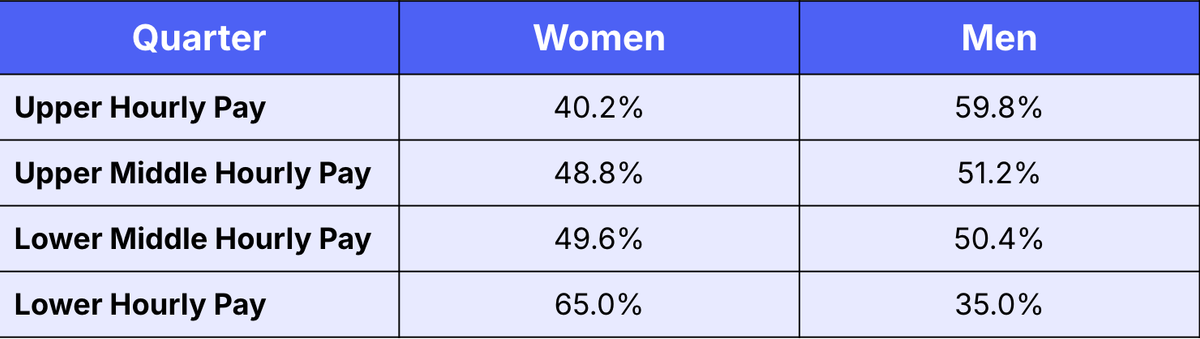
Earnings Quarters
The proportion of men in our UK business increased from 2023 to 2024, leading to a decreased proportion of women at all quarters except for lower hourly pay, meaning that overall we have more men in our highest paid roles and more women in our lowest paid roles. While we are focused on ensuring our organisation is representative of the communities we operate in, at all levels, unfortunately, over-representation of men in high-earning roles is a systemic driver of the gender pay gap; it is at these levels where the most significant pay gaps exist and they have been the slowest to narrow (source).
Explaining our Data
While we are pleased our mean gender pay gap remains lower than the average for the UK Tech and Professional sectors, we acknowledge that our pay gap increased in 2024. While we are beating the average, we strive to be higher performing than the average. In pursuit of this goal, we will continue to work on identifying the causes of our pay gaps and how we can close these. This section sets out some key factors which have influenced our pay gap data this year.
Impacts on Pay
Through intentional steps, we have made progress in many of the focus areas we identified in last year’s report.
Gender Representation in Tech: According to the 2024 'Diversity in Tech' report, women make up 29% of the UK Tech industry. At Multiverse, we have made year-on-year improvements in the representation of women across our Tech team (Engineering, Product, and Data & Insight), which has increased from 31% in 2022, to 35% in 2023, and now 39% in 2024. This highlights how our transparent and consistent hiring framework is enabling us to source brilliant talent and increase our gender representation in critical areas at the same time. Roles in the Tech sector continue to attract more men than women (source) and these roles are often higher paid, so improving gender representation in our Tech team is vital.
Since the snapshot date of 05 April 2024, we have continued to make strides in this area, appointing several women into some of our most senior roles in Tech, including VP Engineering and Director of Product Design & Research. Research shows that women are underrepresented in these fields, making up 20% of Engineering talent (source) and 30% of AI roles (source). Our median Engineering team pay gap for 2024 was -3.8%; however, for Product it was 9.7%, and for Data & Insight 5%.
Sales Commissions: Commissions and other bonuses paid in the month of April are included in our calculation of an employee’s ordinary pay, as required by the UK government. At Multiverse, the only bonuses paid in April are Sales commissions. In previous years, many of our top-performing women in Sales joined our management pathway, which had an accelerating impact on our gender pay gap. We are proud that in 2024, due to several of our highest performing Sales reps being women, the median pay gap for our Sales team was 0%. It is important to note that there is an inherent variability in commission payments, because they are highly dependent on individual in-year performance, and so this picture can change year-on-year. Despite this, we hope our continued focus on bringing a diverse range of talent, including women, into our Sales teams and investing in enablement opportunities for all reps, will help us maintain our strong progress in this area.
However, some key factors have limited our progress:
Senior Representation: A contributing factor to our increased gender pay gap was lower representation of women at our upper pay quarter for 2024, which in real terms, means a decrease in women at “Director” and above levels. Representation at these levels changed from 58% in April 2023, to 42% in April 2024. This was fueled by the departure of our COO and CFO during the 2023-2024 tax year, both of whom were women. As an organisation of less than 1000 employees, we have a small overall population at senior levels and so a small number of key departures can have a significant effect. Since April 2024, we have appointed a new COO and CFO, both of whom are women. This means that our Executive team is currently gender balanced, which is something we are proud of - women occupy 43% of board positions and 35% of Leadership roles at the FTSE 350 level (source).
Lower-Level Representation: The increase in our pay gaps for 2024 is also the result of increased representation of women at our lower pay quarter. While we are always pleased to increase the diversity of our business, having more women in lower-level roles, which are associated with less pay, can particularly impact the mean pay gap. However, several of these lower-level roles held by women were in teams like IT and Finance, which are typically male-dominated, including at lower levels. Having women enter these areas of our business, combined with our aim to provide equitable access to development opportunities, provides a pathway to diversify our future leadership pipeline.
Impacts on Bonuses
Our mean bonus gap decreased in 2024; however, at 33%, it remains higher than we would like. This is closely related to the disproportionate representation of men in our most senior roles at this time, because larger bonus payments are typically granted to employees in these roles.
However, our median bonus gap significantly decreased to -16.5%. As the median figures lessen the impact of outlier figures on each end of the spectrum, this is a useful representation of the picture within Multiverse for the typical employee. The majority of Multiverse employees are on our annual bonus plan, rather than a commission plan. Since our 2023 report, we have made further progress on our approach to data-driven performance reviews, with a rigorous calibration process and structured approach to paying out bonuses based on both company and personal results. Performance ratings have a large impact on bonus payments, and so we believe this is evidence that our new approach is leading to improved outcomes for women at Multiverse.
Our Approach to Closing the Gender Pay Gap
In early 2024, we launched our Career Mobility strategy, which focuses on how we can bring Multiverse’s mission to life for our employees through an equity-first approach to People policies, processes, and practices. We have made a number of strides in our Career Mobility journey so far, which we believe over time will help us close our gender pay gap:
- Pay Philosophy - In late 2022, we started our journey towards pay transparency by creating our first organisation-wide pay philosophy, which is applied to all compensation decisions. Since our last gender pay gap report, we have appointed a dedicated Reward Lead to help us monitor pay equity more closely across the organisation and within departments. Additionally, all employees can now view the pay band for their position in our compensation tool, Pave, and where they sit in the band - a step that only 16% of UK companies have taken (source). We’re continuing to progress with this work and are moving towards even greater transparency, because we believe evidence-based compensation discussions are critical for interrupting bias.
- Equitable Performance Reviews - As discussed earlier in this report, we introduced a structured performance appraisal and calibration process in 2023. Our belief was, and still is, that this would enable us to make more accurate decisions for all employees regarding pay and progression - and we believe this is evidenced by our reduced mean and median bonus gaps. In 2024, we are evolving our approach by taking leaders through a ‘nine-box’ exercise to identify our highest-performing and highest-potential talent. This is the first step in succession planning, which we hope will enable us to take a long-term, business-area agnostic look at our organisation. From this, we will identify opportunities to strengthen and diversify pipelines for key roles, including at senior levels.
- Employee Resource Groups (ERGs) - As well as equitable policies, processes, and practices, building an inclusive culture where everyone can grow and thrive is a key focus for Multiverse. Effective ERGs are shown to increase engagement and reduce attrition for the communities they serve, which means they play a key role in helping us retain high-performing talent from underrepresented backgrounds, including women. In 2024, we launched Women@Multiverse, our fourth ERG. In the nine months since, over 100 employees have joined the ERG and members have held events ranging from ‘Irrational Ways to Influence People’ to ‘Having Challenging Conversations’. Since introducing these networks, employees have reported feeling a greater sense of belonging and community at Multiverse, which is measured by our quarterly employee engagement survey. When combined with the work we are doing to create fairer reward and progression structures, this is likely to increase retention for women across the organisation - something we will monitor across the next 12 months.
- Inclusive Leadership - We want to ensure all People Managers have the tools they need to lead high-performing teams, while supporting individuals to grow and thrive at Multiverse. In early 2024, we launched a 9-month training programme called M-Powering Managers, in partnership with an external training provider. The programme covered key leadership skills from Giving Feedback, to Coaching, and Managing Change. There was also a dedicated session on Diversity, Equity, and Inclusion, specifically focused on practical ways managers can create a sense of belonging within their teams. In 2025, we are planning to introduce a Manager Onboarding programme for all new people managers; inclusive leadership skills and interrupting bias will act as a thread underpinning all three modules.
Conclusion
While reporting our gender pay gap for the 2023-2024 tax year provides an important moment for us to reflect, the work to build a fairer and more equitable Multiverse for every employee does not pause between reports! We are committed to providing equitable access to opportunities internally, as well as in the wider workplace, and will continue to strive to make this a reality at Multiverse.
Tech @ Multiverse: Introducing our new VP of Engineering
Life at Multiverse
Team Multiverse
Helen brings a wealth of experience in the tech industry, most recently leading the engineering team behind Spotify's open-source Backstage product. Her expertise will be instrumental in driving innovation and scaling our engineering organisation as we continue to deliver cutting-edge learning experiences.
A passion for building and empowering:
Helen brings over 15 years of experience in the tech industry, most recently leading the engineering team behind Spotify's open-source Backstage product. Backstage streamlines workflows for developers, and its success is a testament to Helen's leadership in building user-centric and efficient developer tools.
Prior to that, Helen played a key role in launching Podcasts at Spotify, a major expansion of the platform's content offerings at the time. Her dedication to innovation and user experience is evident throughout her career.
"Growing up in a family of educators," says Helen, "I understand the transformative power of education. In today's world, upskilling is essential, and I'm excited to create a learning experience that equips the next generation of talent with the skills they need to thrive."
Beyond her technical expertise, Helen is passionate about fostering strong communities. She is a strong believer in building an engineering culture that not only drives performance but also empowers engineers to learn, grow, and contribute meaningfully to Multiverse's mission.
This new addition underscores our commitment to building a world-class organisation, filled with top talent. Want to join it? We're hiring.
Operations @ Multiverse: Introducing our new VP of Operations
Life at Multiverse
Team Multiverse
Asha joins us with a proven track record of success in building and scaling high-growth companies, most recently as co-founder of Framework. Her expertise in operations, sales and product management will be invaluable as we continue to scale our impact and deliver exceptional learning experiences to our learners.
A champion for growth and opportunity:
Asha joins Multiverse with a wealth of experience in operations, sales, product management, and talent acquisition. She co-founded Framework, a revolutionary edtech company that provides high-growth tech companies with a digital learning experience for their employees. Asha successfully led Framework through a rebrand and pivot, demonstrating her adaptability and strategic thinking.
Prior to Framework, Asha held leadership roles at Education First and boasts a diverse background spanning sales, partnerships, and product development.
"I'm passionate about helping people from all backgrounds grow further in their careers," says Asha. "Multiverse's mission to deliver high-quality, applied learning at scale deeply resonates with me, and I'm excited to be a part of the team."
Asha's proven track record in leading transformative change and her commitment to diversity and inclusion make her a valuable asset to Multiverse. She is eager to leverage her experience to further enhance the quality of Multiverse's offerings and help the company reach new heights.
This new addition underscores our commitment to building a world-class organisation, filled with top talent. Want to join it? We're hiring.
Career Mobility @ Multiverse: Alex Eacker
Life at Multiverse
Alex Eacker
Tell us about your recent career change at Multiverse.
I started at Multiverse over three years ago as a Learning Designer, hired to develop bespoke programs for our US Google partnership. The initial success of that partnership, due to the need to scale the project (developing six programs is a lotof work!), led me to move into a role as a Senior Learning Designer. Subsequently, I progressed to Senior Manager, where I was responsible for managing a team of Learning Designers working across a variety of bespoke programs.
When this new role opened up on the Enterprise team, I had established myself as an expert in creating bespoke programs for our global customers (Google, Verizon, Babcock, to name a few). The role fit well with the skill set I had been developing over the past few years, as well as giving me an opportunity to manage a larger team.
How are you enjoying your new team and remit?
I'm doing my best! This new role requires me to build strong relationships with leaders and teams across Multiverse, which has been a really awesome way to learn about the intricacies of our business and meet some really smart and passionate people.
It also requires me to be creative and challenge my assumptions about what's possible. My team’s aim is to unlock new revenue opportunities by building custom content for customers, but it's not always obvious how we should be doing this. The role requires my team and I to think critically about our product as a whole, and find ways to improve or modify it to meet customers needs.
Any career change comes with its challenges, what did you have to overcome and how did you approach this?
I mentioned this earlier, but I was independently developing six programs and the customer had high-expectations and often required us to create additional resources that took up a lot of time and energy. I needed a way to objectively demonstrate the workload to effectively manage client expectations and advocate for support within Multiverse. To address these challenges, I invested significant time in implementing project management tools and adopting Story Points as a framework for capacity planning. The data I was able to collect helped me visualize the scope of the project I was working on, and helped me identify trends in the workload over the year to determine when I needed the most support. These reporting mechanisms ultimately led to me building a case for a larger team, and pushed me into a management position.
If you could share one piece of advice for someone looking to develop their career or move internally, what would it be?
It's important to be open with your manager about your career goals and aspirations. Share what matters most to you in your role and how you envision your professional growth. These conversations can feel daunting! Especially if your ambitions seem challenging or different from current opportunities, but your manager should be supportive of your success, and work with you to get there. You might be surprised at how transparency can unlock new possibilities. Simply put, your manager and colleagues can't effectively support you if they don't know your goals and what you're striving for.
Want to join a company where career mobility is a priority? We’re hiring.
Product craft at Multiverse
Life at Multiverse
Robbie Tilleard and Tanja Krawetz
We’re ambitious about the impact we want to create, and a key part of this is Multiverser’s development. With competency mastery at our core, we recently refreshed how we think about Product Management as a craft. Today, we’re sharing our new internal framework for Product Managers (PMs) at every level at Multiverse.
Our goal for the framework is that it’s fair, actionable, and measurable. It should create a pathway for great Product Management through clear expectations, speak to every aspect of the product development lifecycle, and help PMs—and Multiverse—grow.
The evolution of Product Management at Multiverse
Our team has experience across the spectrum—from seed-stage startups to public companies, including Google, Spotify, Meta, Hubspot, and more. With this wealth of knowledge, we initially adopted a simple way to understand Product Management: by asking four key questions (4Q) that focused on impact, speed, product expertise, and leadership.
- Are you achieving impact? It all comes down to this. You need to build software our users want and love.
- Do you ship at pace? We’re a scale-up and still have a lot to build. We need to be nimble and build fast.
- Are you the expert on our user and product? The more you understand user needs and the product, the higher the chance of building the right tools and features for impact.
- Are you leading and motivating your team, stakeholders, and organisation? If everyone shares the same mental model of the user and business goals and is excited about what you are building, the faster you can ship.
This simple rubric served us well during our rapid growth. It helped ensure that PMs delivered for users, shipped at a pace, and led their teams effectively. However, as Multiverse grew to 800+ employees and our product team matured, we needed something more robust.
Introducing our new competency framework
Our new framework uses the Driver Tree approach—a more dynamic, outcome-focused way to align every PM’s growth with business impact, rooted in the original intentions behind the 4Q approach. The Driver Tree links each category of competencies— shipping, mastery, and leadership—directly to role-specific expectations, making it clear how PMs at each level can create user value by driving the product's and the business's success.

The framework avoids ambiguity by detailing the skills required at every role level. As PMs progress in their careers, they take on greater responsibility and more complex problem spaces. The framework will help them navigate this progression by clearly defining what success looks like at each stage. PMs can assess their standing and provide clear, concrete examples of what is expected at each level.
Try the framework yourself
We’re excited to open up this framework for anyone to use. Take a look at it here, make a copy, and feel free to adapt it to your teams. As Multiverse continues to grow and evolve, so will this framework. We welcome any feedback and look forward to hearing how it works for you.
Introducing our new Disabilities @ Multiverse ERG Chair
Life at Multiverse
Meelie Thorpe
ERGs are groups created for employees and led by people who share common life experiences or identities. Typically, these groups are comprised of people within communities that have been historically and systemically marginalised.
ERGs provide support and safe space for underrepresented and/or marginalised communities. They help employees in their professional development, increase engagement and retention, and drive towards organisation-wide goals. Disabilities @ Multiverse is a community for those who identify as having an apparent, non-apparent, short term, long term disability and/or identify as neurodivergent. Our ERG is open to all employees who are passionate about creating an inclusive workplace for individuals with disabilities.
We sat down with Meelie Thorpe, Apprentice Support Executive based in our London and the new Disabilities @ Multiverse Chair, to talk about her new role.
What inspired you to run for Chair of Disabilities @ Multiverse?
My incredible colleagues who form the heart and soul of Multiverse inspired me to run for Chair. I am continually excited by the idea of creating a vibrant space where we can all share, connect, and enjoy the company of people who experience the world in a similar way. For me, it's essential that this community encourages connection and sharing, but also advocacy and learning. I’m passionate about having a tangible, positive impact on our employee experience!
What is the main goal of your ERG?
My main goal of the ERG is to cultivate an inclusive and empowering environment for employees with disabilities and allies, promoting awareness, support, and career growth opportunities within the company. Our aim is to enhance workplace experiences and create an equitable and inclusive community where disability can be celebrated! Conscious inclusion is at the heart of everything we do.
Why do you think the ERG is important?
For me, it is important to make meaningful contributions to creating an equitable and inclusive experience for all employees. The barriers that people with disabilities face in society mean that often we do not have the same opportunities as our peers. The ERG is an important step towards bridging that gap, and creating a safe space for members to contribute to the growth and development of employee experiences at Multiverse.
What are you proud of achieving so far?
So far we’ve already had amazing opportunities to share through our quarterly events and monthly meetings.
In September we put on an internal roundtable titled: Voices of Strength: Creating Accessible Spaces at Multiverse. Which we put on to provide a platform for employees with disabilities to share their experiences, insights, and discuss key topics related to workplace inclusion, accessibility, and support.
And in celebration of International Day of Persons with Disabilities in December, we’re putting on a series of events:
- A neurodiversity champion workshop.
- An inclusive manager workshop.
- And a session on making our product (even) more accessible.
If our commitment to diversity inspires you and you wish to be a part of a company that invests genuinely in its people, we would love to have you on board. See live roles.
Career Mobility @ Multiverse: Alexander Howarth
Life at Multiverse
Team Multiverse
Tell us about your recent career change at Multiverse.
I joined Multiverse in May 2022 as a Coach in what was then the Data Literacy Programme (DLP). During our first DLP cohort, this programme went from strength to strength, developing into the Data and Insights for Business Decisions (DIBD) programme we know today!
I was invited to apply for an Operations Executive role pilot because of some analysis work I’d done alongside my coaching role. It was a brilliant opportunity to get stuck in with the first iterations of projects to support coaches with our new approach to organising and maintaining high-quality service during our programmes, which are now rolling out across the business.
How are you enjoying your new team and remit?
I've been in the role for six months and I'm loving it! It's great to be able to have an impact on the success of thousands of apprentices, rather than one cohort. I've also gone from quite a structured role as a coach, with defined apprentice touch points, to a role where no two days or weeks are the same. I've found this really refreshing and energising, working with so many more great colleagues across the organisation.
Any career change comes with its challenges, what did you have to overcome and how did you approach this?
One of the best things about working at Multiverse is the wealth of experience you're surrounded by all the time, and how willing people are to share it with you. I have had to adapt to thinking on a larger scale - instead of imagining solutions to problems my cohort of apprentices were facing, which I would devise and implement entirely on my own, I now work on fixing problems for thousands of apprentices.
I have to think through how effectively solutions can be adopted by coaches with competing demands on their time and attention. I've borrowed an old Nike slogan - 'Just do it!' - and lean heavily on colleagues who have expertise and skills that I'm still developing.
If you could share one piece of advice for someone looking to develop their career or move internally, what would it be?
Volunteer for things! I only got the Operations Exec Pilot opportunity because I asked my Delivery Lead if there was anything else I could be doing to develop, so make sure you put yourself out there and say yes!
Alex’s journey from Data Coach to Operations Executive showcases our Career Mobility approach at Multiverse and highlights the importance of keeping an open mind and jumping at opportunities when wanting to make a career change. Want to join a company where career mobility is a priority? We’re hiring.
Career Mobility @ Multiverse: Ola Awosika
Life at Multiverse
Team Multiverse
Tell us about your recent career change at Multiverse.
I joined Multiverse two and a half years as a Business Operations Manager, working on things like driving efficiency during secondments, or Project Managing software sunsetting journeys. After 6 months in the role I was promoted to Head of Business Operations and was looking after a small but mighty team of internal fixers!
Shortly afterward I was diagnosed with Cancer which saw me need to take extended medical leave whilst undergoing treatment. Now I am back (Cancer-free!) and the scope of my role has become both broader and deeper. I now look after internal operations, covering the services needed for Multiversers to get their jobs done.
How are you enjoying your new team and remit?
It’s been an incredible six months, and I’m loving my new role! The opportunity to bring functions together—and, in some cases, to build them from the ground up—has been both exhilarating and rewarding. We’ve accomplished a great deal in a short time, delivering significant value for the business and Multiversers, with even more exciting plans on the horizon.
Any career change comes with its challenges, what did you have to overcome and how did you approach this?
One of the most interesting challenges has been balancing sustainability with velocity - we aim to strengthen Multiverse’s security and maturity while fostering innovative growth. In this role, my team and I have been passionately focused on optimizing ‘Time to Value’, which means making things more effective and efficient. Many systems and processes have been built to address specific needs, but as the organization expands, it's crucial for us to adapt our ways of working to accommodate new priorities, even when they don’t fit neatly into our current framework. For example, we’ve built an internal ticketing system, Multibot, and are leading Project Fortress, which aims to enhance our security and achieve multiple ISO certifications.
To tackle these challenges, we embraced a proactive mindset, taking ownership of identifying and bridging the gaps wherever identified. This means having strong relationships cross-functionally to encourage collaboration and creative problem solving. We also aim to be as agile and flexible as possible to ensure we not only meet current demands, but lay a robust foundation for future growth. It’s been a rewarding journey that has taught me the importance of adaptability and the value of a cohesive team in navigating change.
If you could share one piece of advice for someone looking to develop their career or move internally, what would it be?
Engage with others! It can be daunting when you’re unsure about the unknowns in your career, but gaining insights from those around you is invaluable. Reach out to a senior leader you admire or connect with a colleague who has faced similar challenges; remember, your situation isn’t unique (and that’s perfectly okay). Learning from others who’ve walked a similar path can provide guidance and clarity.
Moreover, embrace change—it’s the only constant! While navigating change can be challenging, it doesn’t have to be overwhelming. Take a moment to reflect: when was the last time you embraced change, and when did you resist it? Understanding the gaps in your approach can help you fine-tune your adaptability to transformation. By cultivating this skill, you empower yourself to thrive in an ever-evolving landscape.
Ola’s journey from Business Operations Manager to Head of Business Operations showcases our Career Mobility approach at Multiverse and highlights the importance of embracing change and the challenge that comes with it when wanting to make a career change. Want to join a company where career mobility is a priority? We’re hiring.
Introducing our new Black @ Multiverse ERG Chair
Life at Multiverse
Sarah Olubunmi
ERGs are groups created by and for employees, bringing together people who share common life experiences or identities. Typically, these groups are comprised of people within communities that have been historically and systemically marginalised. ERGs provide support and a safe space for underrepresented and/or marginalised communities. They help employees in their professional development, increase engagement and retention, champion their members’ point of view, and help us drive towards our organisation-wide goal of a Multiverse where every employee can Grow and Thrive.
Black @ Multiverse is a network fostering support, connection, and development for individuals identifying with the Black Diaspora. Our aim is to cultivate a sense of belonging, aiding in the advancement and retention of our members at Multiverse. Whether you identify as belonging to the African Diaspora or as an ally, everyone is welcome to join us in our mission to promote diversity and inclusion!
We sat down with Sarah Olubunmi, a Product Manager based in our London office and our Black @ Multiverse Chair, to talk about her new role.
What inspired you to run for Chair of the Black @ Multiverse ERG?
I have a deep understanding of both the unique challenges and the strengths that come with being Black. I wanted to channel my lived experience, alongside my leadership and business expertise, to create an even more inclusive community within the company. My inspiration comes from a desire to empower and uplift Black employees, while also educating our allies. By sharing Black narratives and celebrating diversity, I hope to make a lasting impact and foster a greater sense of belonging for everyone.
What is the main goal of your ERG?
Our primary goal is to support the ongoing work to create a truly inclusive environment, where Black employees feel supported, empowered, and valued. We aim to achieve this by focusing on three key objectives:
- Enhancing career development and mentorship opportunities for Black employees.
- Celebrating Black culture and educating others about the richness and diversity of our experiences.
- Addressing the challenges that Black employees may face, particularly around inclusion and belonging, and working to create tangible solutions.
Why do you think the ERG is important?
The ERG plays a vital role in creating a space where Black employees can feel seen, heard, and respected. It helps build a community where people can share their experiences and find support, both professionally and personally. The ERG also serves as an educational tool for the wider organisation, allowing allies to learn more about the Black experience and how they can contribute to a more inclusive workplace. Ultimately, it’s about fostering a culture of understanding and celebration of our differences, which makes the entire company stronger.
What is your favourite event you’ve put on so far?
One of my favourite events was the fireside chat I hosted in partnership with BYP Network, where I shared insights into my own career progression. It was an amazing opportunity to provide tangible advice and tips to help others advance in their careers.
I also loved hosting our Notting Hill Carnival panel in August - it was incredibly powerful and informative. We discussed the history and cultural significance of Carnival, helping to dispel some of the common misconceptions. The feedback was overwhelmingly positive, and we had over 100 attendees, which made it feel even more impactful.

What are the big plans for the ERG this year?
We have an exciting year ahead! One of our key events will be attending the Black Tech Fest, which is an incredible opportunity to connect with like-minded professionals and showcase the talent within our community. We’re also planning a series of Black History Month celebrations, including a dynamic panel event followed by an after-party. These events are all about celebrating Black culture, empowering our members, and continuing to build a stronger, more inclusive environment for everyone.
If our commitment to diversity inspires you and you wish to be a part of a company that invests genuinely in its people, we would love to have you on board. See open roles.
How to use prompt engineering to create your 3 Whys
Life at Multiverse
Enterprise Sales Community
This blog will walk you through a curated set of prompts designed to help AEs gather essential insights, align offerings, and ultimately create compelling sales narratives that resonate with clients - also known as the 3 Whys. From understanding the business landscape to crafting the perfect pitch, these prompts are your roadmap to successful client engagement and will help you get on the road to becoming AI native.
The Prompts:
Prompt 1a: Company Landscape, Mission and Objectives
"Please provide a summary of the key industry themes and landscape that [PROSPECTIVE COMPANY] operates in. Particularly share the trends and phrases used in industry press to describe the obstacles and opportunities broadly in the [YOUR COMPANY’S INDUSTRY}.
Prompt 1b:
“Capture the company's mission statement or vision. Then, create a table that outlines the key business objectives for [Business URL]. Ensure that the table highlights why these objectives are critical for the company’s success and how they align with its long-term vision, stakeholder/shareholder and customer value. Include references to [YOUR COMPANY’S USP]."
- Purpose: Helps AEs understand the business landscape/context, strategic vision and goals of the client, providing a link for identifying relevant challenges [YOUR COMPANY] may solve for.
Prompt 2: Identifying Key Challenges and Root Causes
"Based on the company’s strategic goals outlined in the attached document/above, identify three major challenges for each that could prevent [Business URL] from achieving these objectives. For each challenge, detail the underlying root causes, including organisational, technical, or market-related factors. Ensure you consider potential risks associated with these challenges."
- Purpose: Guides AEs to focus on specific challenges that hinder the company’s strategic goals, helping to uncover deeper issues and precipitating thinking around use cases and skill/knowledge/behaviour gaps [YOUR COMPANY] may solve for.
Prompt 3: Aligning [YOUR COMPANY] Capabilities
"For each of the key challenges identified in the previous prompt, suggest how [YOUR COMPANY]’s solutions can help address these challenges. Provide examples from the attached [PROOF POINTS/CASE STUDIES] document of how similar solutions have been implemented or could be implemented. Highlight the potential impact on the company’s strategic objectives and start to align these to commercial impact around Revenue, Cost/Risk mitigation or Cost avoidance."
- Purpose: Enables AEs to directly align [YOUR COMPANY]’s offerings with the client's needs, demonstrating how these solutions can resolve key challenges that impact top/bottom line.
Prompt 4: Risk Analysis and Metrics
"Create a detailed risk analysis for each of the challenges identified, considering both the risks of not addressing the challenges and the potential pitfalls of proposed solutions. Include metrics that could be used to track the success of these solutions. Refer to the attached document for any relevant examples or insights."
- Purpose: Encourages AEs to think critically about the risks and metrics associated with proposed solutions, ensuring they can articulate the value and mitigate concerns.
Prompt 5: Structuring the 3 Whys Narrative
"Using the information gathered from the previous prompts, structure a concise '3 Whys' narrative that could be presented to stakeholders. This should include:
- Why Anything? - Explain the importance of addressing the identified challenges.
- Why Now? - Urge the need for immediate action, supported by data and trends.
- Why [YOUR COMPANY]? - Highlight why [YOUR COMPANY] is uniquely positioned to solve these challenges and the expected business impact."
- Purpose: Helps AEs create a compelling narrative that resonates with the client’s executives, ensuring that the solution is seen as timely and necessary.
Guidance for Implementation
These prompts should be used iteratively throughout the sales process, starting from the discovery phase and building up to the final proposal and presentation. By following this structured approach, account executives can effectively uncover the root causes of buyer problems, align [YOUR COMPANY]’s offerings with client needs, and present a compelling case that drives decision-making.
Tip: Encourage AEs to tailor the language and examples in the prompts to the specific client industry and context, leveraging data and insights from the attached document to add credibility and relevance to their proposals.
By leveraging the prompts outlined in this guide, AEs can ensure they are addressing the core challenges their clients face, aligning solutions that offer tangible value, and constructing persuasive narratives that drive decision-making. Remember, the key to successful prompt engineering lies in its iterative application throughout the sales process. Tailor your language and examples to the client's specific industry context to maximize relevance and impact.
Master these prompts to streamline your sales process, increase efficiency, and transform every client conversation into a strategic advantage – happy selling!
Sorry, no results found.